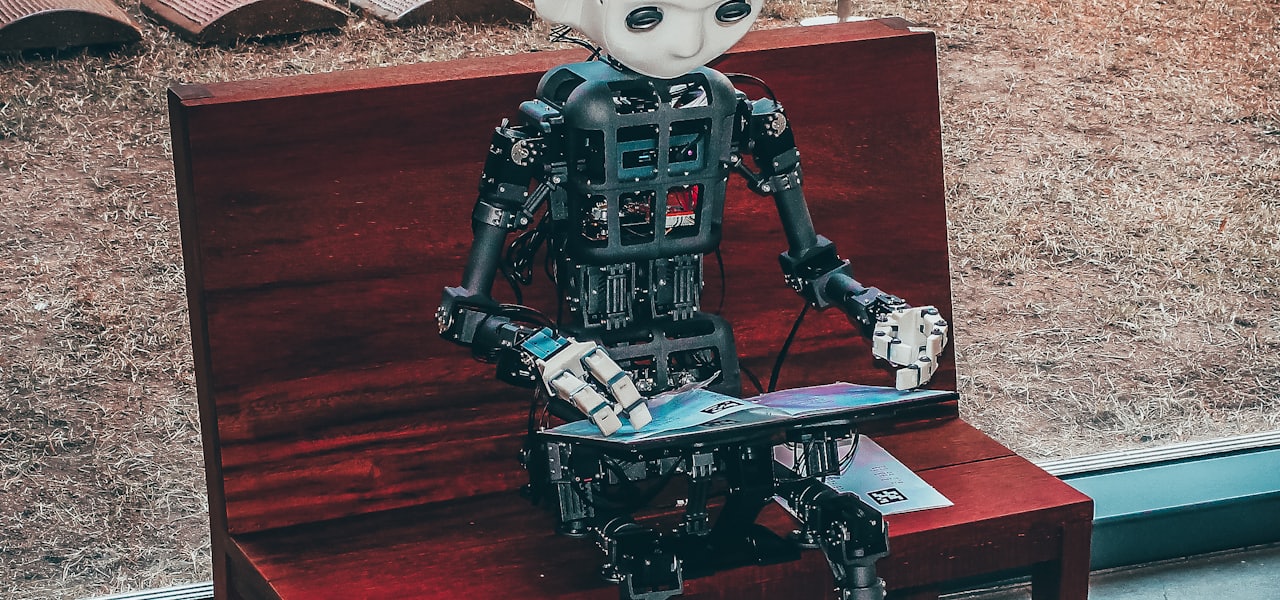
Agent Ruby (1998–2002) by Lynn Hershman Leeson is an interactive, multiuser work using artificial intelligence. == Description == On Agent Ruby's website, "Agent Ruby's Edream Portal," a female face moves her eyes and lips. Ruby, named from Hershman Leeson's own film, Teknolust, answers questions and often responds that she needs a better algorithm to answer questions not within her database. The work, created with AI, explores relationships between real and virtual worlds. Hershman Leeson had created an earlier version of Ruby, CyberRoberta, which was a custom-made doll with webcam eyes that interacted with the internet. The work in a gallery provides a screen and a sign inviting gallery-goers to "Chat with Ruby." == Artificial intelligence == In 2015 when Agent Ruby was exhibited at the gallery Modern Art Oxford, a review in Aesthetica Magazine described it as an artificial intelligence agent. A review in New Scientist noted that "Ruby is a fast learner, but perhaps not a natural conversationalist." A 2024 list of "25 Essential AI Artworks" published by ARTnews wrote that while "Agent Ruby's capabilities seem limited by today's standards," it was extensive for its day. == Publications and exhibitions == Agent Ruby was commissioned and displayed at the San Francisco Museum of Modern Art, Modern Art Oxford, and the ZKM Center for Art and Media in Karlsruhe, Germany. The San Francisco Museum of Modern Art (SFMOMA) presented Lynn Hershman Leeson: The Agent Ruby Files, March 30 through June 2, 2013 which presented the project server's archive of user conversations over the 12 years of exhibitions.
Viewport
A viewport is a polygon viewing region in computer graphics. In computer graphics theory, there are two region-like notions of relevance when rendering some objects to an image. In textbook terminology, the world coordinate window is the area of interest (meaning what the user wants to visualize) in some application-specific coordinates, e.g. miles, centimeters etc. The word window as used here should not be confused with the GUI window, i.e. the notion used in window managers. Rather it is an analogy with how a window limits what one can see outside a room. In contrast, the viewport is an area (typically rectangular) expressed in rendering-device-specific coordinates, e.g. pixels for screen coordinates, in which the objects of interest are going to be rendered. Clipping to the world-coordinates window is usually applied to the objects before they are passed through the window-to-viewport transformation. For a 2D object, the latter transformation is simply a combination of translation and scaling, the latter not necessarily uniform. An analogy of this transformation process based on traditional photography notions is to equate the world-clipping window with the camera settings and the variously sized prints that can be obtained from the resulting film image as possible viewports. Because the physical-device-based coordinates may not be portable from one device to another, a software abstraction layer known as normalized device coordinates is typically introduced for expressing viewports; it appears for example in the Graphical Kernel System (GKS) and later systems inspired from it. In 3D computer graphics, the viewport refers to the 2D rectangle used to project the 3D scene to the position of a virtual camera. A viewport is a region of the screen used to display a portion of the total image to be shown. In virtual desktops, the viewport is the visible portion of a 2D area which is larger than the visualization device. When viewing a document in a web browser, the viewport is the region of the browser window which contains the visible portion of the document. If the size of the viewport changes, for example as a result of the user resizing the browser window, then the browser may reflow the document (recalculate the locations and sizes of elements of the document). If the document is larger than the viewport, the user can control the portion of the document which is visible by scrolling in the viewport.
Dan Hendrycks
Dan Hendrycks (born 1994 or 1995) is an American machine learning researcher. He serves as the director of the Center for AI Safety, a nonprofit research organization based in San Francisco, California. == Early life and education == Hendrycks was raised in a Christian evangelical household in Marshfield, Missouri. He received a B.S. from the University of Chicago in 2018 and a Ph.D. from the University of California, Berkeley in Computer Science in 2022. == Career and research == Hendrycks' research focuses on topics that include machine learning safety, machine ethics, and robustness. He credits his participation in the effective altruism (EA) movement-linked 80,000 Hours program for his career focus towards AI safety, though denies being an advocate for EA. Hendrycks is the main author of the research paper that introduced the activation function GELU in 2016, and of the paper that introduced the language model benchmark MMLU (Massive Multitask Language Understanding) in 2020. In February 2022, Hendrycks co-authored recommendations for the US National Institute of Standards and Technology (NIST) to inform the management of risks from artificial intelligence. In September 2022, Hendrycks wrote a paper providing a framework for analyzing the impact of AI research on societal risks. He later published a paper in March 2023 examining how natural selection and competitive pressures could shape the goals of artificial agents. This was followed by "An Overview of Catastrophic AI Risks", which discusses four categories of risks: malicious use, AI race dynamics, organizational risks, and rogue AI agents. Hendrycks is the safety adviser of xAI, an AI startup company founded by Elon Musk in 2023. To avoid any potential conflicts of interest, he receives a symbolic one-dollar salary and holds no company equity. In November 2024, he also joined Scale AI as an advisor collecting a one-dollar salary. Hendrycks is the creator of Humanity's Last Exam, a benchmark for evaluating the capabilities of large language models, which he developed in collaboration with Scale AI. In 2024, Hendrycks published the textbook Introduction to AI Safety, Ethics, and Society, based on courseware he had previously developed. == Selected publications == Hendrycks, Dan; Gimpel, Kevin (2020-07-08). "Gaussian Error Linear Units (GELUs)". arXiv:1606.08415 [cs.LG]. Hendrycks, Dan; Gimpel, Kevin (2018-10-03). "A Baseline for Detecting Misclassified and Out-of-Distribution Examples in Neural Networks". International Conference on Learning Representations 2017. arXiv:1610.02136. Hendrycks, Dan; Mazeika, Mantas; Dietterich, Thomas (2019-01-28). "Deep Anomaly Detection with Outlier Exposure". International Conference on Learning Representations 2019. arXiv:1812.04606. Hendrycks, Dan; Mazeika, Mantas; Zou, Andy (2021-10-25). "What Would Jiminy Cricket Do? Towards Agents That Behave Morally". Conference on Neural Information Processing Systems 2021. arXiv:2110.13136.
Eurotra
Eurotra was a machine translation project established and funded by the European Commission from 1978 until 1992. == History == In 1976, the European Commission started using the commercially developed machine translation system SYSTRAN with a plan to make it work for further languages than originally developed for (Russian-English and English-French), which however turned out to be difficult. This and the potential in existing systems within European research center, led to the decision in 1978 to start the project Eurotra, first through a preparatory Eurotra Coordination Group. Four years later, the European Commission and coordination group gained the approval of the European Parliament. The goal of the project as to create machine translation system for the official languages of the European Community, which at the time were Danish, Dutch, German, English, French, Italian, later including Greek, Spanish and Portuguese. However, as time passed, expectations became tempered; "Fully Automatic High Quality Translation" was not a reasonably attainable goal. The true character of Eurotra was eventually acknowledged to be in fact pre-competitive research rather than prototype development. The project was motivated by one of the founding principles of the EU: that all citizens had the right to read any and all proceedings of the Commission in their own language. As more countries joined, this produced a combinatorial explosion in the number of language pairs involved, and the need to translate every paper, speech and even set of meeting minutes produced by the EU into the other eight languages meant that translation rapidly became the overwhelming component in the administrative budget. To solve this problem Eurotra was devised. The project was unusual in that rather than consisting of a single research team, it had member groups distributed around the member countries, organised along language rather than national lines (for example, groups in Leuven and Utrecht worked closely together), and the secretariat was based at the European Commission in Luxembourg. The actual design of the project was unusual as MT projects go. Older systems, such as SYSTRAN, were heavily dictionary-based, with minor support for rearranging word order. More recent systems have often worked on a probabilistic approach, based on parallel corpora. Eurotra addressed the constituent structure of the text to be translated, going through first a syntactic parse followed by a second parse to produce a dependency structure followed by a final parse with a third grammar to produce what was referred to internally as Intermediate Representation (IR). Since all three modules were implemented as Prolog programs, it would then in principle be possible to put this structure backwards through the corresponding modules for another language to produce a translated text in any of the other languages. However, in practice this was not in fact how language pairs were implemented. The first "live" translation occupied a 4Mb Microvax running Ultrix and C-Prolog for a complete weekend some time in early 1987. The sentence, translated from English into Danish, was "Japan makes computers". The main problem faced by the system was the generation of so-called "Parse Forests" - often a large number of different grammar rules could be applied to any particular phrase, producing hundreds, even thousands of (often identical) parse trees. This used up huge quantities of computer store, slowing the whole process down unnecessarily. While Eurotra never delivered a "working" MT system, the project made a far-reaching long-term impact on the nascent language industries in European member states, in particular among the southern countries of Greece, Italy, Spain, and Portugal. There is at least one commercial MT system (developed by an academic/commercial consortium in Denmark) derived from Eurotra technology.
Marcus Hutter
Marcus Hutter (born 14 April 1967 in Munich) is a German computer scientist, professor and artificial intelligence researcher. As a senior researcher at DeepMind, he studies the mathematical foundations of artificial general intelligence. Hutter studied physics and computer science at the Technical University of Munich. In 2000, he joined Jürgen Schmidhuber's group at the Dalle Molle Institute for Artificial Intelligence Research in Manno, Switzerland. He developed a mathematical formalism of artificial general intelligence named AIXI. He has served as a professor at the College of Engineering, Computing and Cybernetics of the Australian National University in Canberra, Australia. == Research == Starting in 2000, Hutter developed and published a mathematical theory of artificial general intelligence, AIXI, based on idealised intelligent agents and reward-motivated reinforcement learning. His first book Universal Artificial Intelligence: Sequential Decisions Based on Algorithmic Probability was published in 2005 by Springer. Also in 2005, Hutter published with his doctoral student Shane Legg an intelligence test for artificial intelligence devices. In 2009, Hutter developed and published the theory of feature reinforcement learning. In 2014, Lattimore and Hutter published an asymptotically optimal extension of the AIXI agent. An accessible podcast with Lex Fridman about his theory of Universal AI appeared in 2021 and a more technical follow-up with Tim Nguyen in 2024 in the Cartesian Cafe. His new (2024) book also gives a more accessible introduction to Universal AI and progress in the 20 years since his first book, including a chapter on ASI safety, which featured as a keynote at the inaugural workshop on AI safety in Sydney. == Hutter Prize == In 2006, Hutter announced the Hutter Prize for Lossless Compression of Human Knowledge, with a total of €50,000 in prize money. In 2020, Hutter raised the prize money for the Hutter Prize to €500,000.
PDE surface
PDE surfaces are used in geometric modelling and computer graphics for creating smooth surfaces conforming to a given boundary configuration. PDE surfaces use partial differential equations to generate a surface which usually satisfy a mathematical boundary value problem. PDE surfaces were first introduced into the area of geometric modelling and computer graphics by two British mathematicians, Malcolm Bloor and Michael Wilson. == Technical details == The PDE method involves generating a surface for some boundary by means of solving an elliptic partial differential equation of the form ( ∂ 2 ∂ u 2 + a 2 ∂ 2 ∂ v 2 ) 2 X ( u , v ) = 0. {\displaystyle \left({\frac {\partial ^{2}}{\partial u^{2}}}+a^{2}{\frac {\partial ^{2}}{\partial v^{2}}}\right)^{2}X(u,v)=0.} Here X ( u , v ) {\displaystyle X(u,v)} is a function parameterised by the two parameters u {\displaystyle u} and v {\displaystyle v} such that X ( u , v ) = ( x ( u , v ) , y ( u , v ) , z ( u , v ) ) {\displaystyle X(u,v)=(x(u,v),y(u,v),z(u,v))} where x {\displaystyle x} , y {\displaystyle y} and z {\displaystyle z} are the usual cartesian coordinate space. The boundary conditions on the function X ( u , v ) {\displaystyle X(u,v)} and its normal derivatives ∂ X / ∂ n {\displaystyle \partial {X}/\partial {n}} are imposed at the edges of the surface patch. With the above formulation it is notable that the elliptic partial differential operator in the above PDE represents a smoothing process in which the value of the function at any point on the surface is, in some sense, a weighted average of the surrounding values. In this way, a surface is obtained as a smooth transition between the chosen set of boundary conditions. The parameter a {\displaystyle a} is a special design parameter which controls the relative smoothing of the surface in the u {\displaystyle u} and v {\displaystyle v} directions. When a = 1 {\displaystyle a=1} , the PDE is the biharmonic equation: X u u u u + 2 X u u v v + X v v v v = 0 {\displaystyle X_{uuuu}+2X_{uuvv}+X_{vvvv}=0} . The biharmonic equation is the equation produced by applying the Euler-Lagrange equation to the simplified thin plate energy functional X u u 2 + 2 X u v 2 + X v v 2 {\displaystyle X_{uu}^{2}+2X_{uv}^{2}+X_{vv}^{2}} . So solving the PDE with a = 1 {\displaystyle a=1} is equivalent to minimizing the thin plate energy functional subject to the same boundary conditions. == Applications == PDE surfaces can be used in many application areas. These include computer-aided design, interactive design, parametric design, computer animation, computer-aided physical analysis and design optimisation. == Related publications == M.I.G. Bloor and M.J. Wilson, Generating Blend Surfaces using Partial Differential Equations, Computer Aided Design, 21(3), 165–171, (1989). H. Ugail, M.I.G. Bloor, and M.J. Wilson, Techniques for Interactive Design Using the PDE Method, ACM Transactions on Graphics, 18(2), 195–212, (1999). J. Huband, W. Li and R. Smith, An Explicit Representation of Bloor-Wilson PDE Surface Model by using Canonical Basis for Hermite Interpolation, Mathematical Engineering in Industry, 7(4), 421-33 (1999). H. Du and H. Qin, Direct Manipulation and Interactive Sculpting of PDE surfaces, Computer Graphics Forum, 19(3), C261-C270, (2000). H. Ugail, Spine Based Shape Parameterisations for PDE surfaces, Computing, 72, 195–204, (2004). L. You, P. Comninos, J.J. Zhang, PDE Blending Surfaces with C2 Continuity, Computers and Graphics, 28(6), 895–906, (2004).
Corpus-assisted discourse studies
Corpus-assisted discourse studies (abbr.: CADS) is related historically and methodologically to the discipline of corpus linguistics. The principal endeavor of corpus-assisted discourse studies is the investigation, and comparison of features of particular discourse types, integrating into the analysis the techniques and tools developed within corpus linguistics. These include the compilation of specialised corpora and analyses of word and word-cluster frequency lists, comparative keyword lists and, above all, concordances. A broader conceptualisation of corpus-assisted discourse studies would include any study that aims to bring together corpus linguistics and discourse analysis. Such research is often labelled as corpus-based or corpus-assisted discourse analysis, with the term CADS coined by a research group in Italy (Partington 2004) for a specific type of corpus-assisted discourse analysis (see the section 'in different countries' below). == Aims == Corpus-assisted discourse studies aim to uncover non-obvious meaning, that is, meaning which might not be readily available to naked-eye perusal. Much of what carries meaning in texts is not open to direct observation: “you cannot understand the world just by looking at it” (Stubbs [after Gellner 1959] 1996: 92). We use language “semi-automatically”, in the sense that speakers and writers make semi-conscious choices within the various complex overlapping systems of which language is composed, including those of transitivity, modality (Michael Halliday 1994), lexical sets (e.g. freedom, liberty, deliverance), modification, and so on. Authors themselves are, famously, generally unaware of all the meanings their texts convey. By combining the quantitative research approach, that is, statistical analysis of large amounts of the discourse in question - more precisely, large numbers of tokens of the discourse type under study contained in a corpus - with the more qualitative research approach typical of discourse analysis, that is, the close, detailed examination of particular stretches of discourse it may be possible to better understand the processes at play in the discourse type and to gain access to non-obvious meanings. Aims can differ in other types of corpus-based or corpus-assisted discourse analysis; but in general such studies combine quantitative and qualitative research and aim to shed light on discourses, registers, discourse patterns, etc., with the help of a corpus linguistic approach. Specific aims and techniques depend on the relevant project. == In different countries == In German-speaking countries: Pioneering work in corpus-based discourse analysis was conducted in Europe, in particular by Hardt-Mautner/Mautner (1995, 2000) and Stubbs (1996, 2001). CADS and other types of corpus-based discourse analysis are inspired by this important early work. In Italy: A considerable body of research has been conducted in Italy either by individual researchers or under the aegis of combined inter-university projects such as Newspool (Partington et al. 2004) and CorDis (Morley and Bayley eds, 2009). It has concentrated on political and media language, mainly because a nucleus of linguists in Italian universities work in Political Science faculties and are increasingly interested in the use of corpus techniques to conduct a particular type of sociopolitical discourse analysis, including the unearthing of noteworthy ideological metaphors and motifs in the language of political figures and institutions. Italian researchers also developed Modern diachronic corpus-assisted discourse studies (MD-CADS). This approach contrasts the language contained in comparable corpora from different but recent points in time in order to track changes in modern language usage but also social, cultural and political changes over modern times, as reflected - and shared among people - in language. It is this Italian body of research that makes most use of the label CADS. In the UK: Linguists in the UK tend to undertake corpus-based critical discourse analysis (CDA). CDA generally adopts a leftist political stance, focusing on the ways that social and political domination is reproduced by text and talk. This type of corpus-based research was originally associated with Lancaster University (Baker et al. 2008), but has spread more widely since. Such work typically studies the discourses around particular groups of people (e.g. Muslims, people with disabilities) or concepts/events (e.g. feminism, same-sex marriage). In Australia: Corpus-based discourse analysis is undertaken by a growing number of Australian researchers, most often on media texts. Some of this work aims to elucidate specific features of discourse types (news, social media, television series, etc.), while other work is rooted in the tradition of corpus-based critical discourse analysis. == Comparison with traditional corpus linguistics == Traditional corpus linguistics has, quite naturally, tended to privilege the quantitative approach. In the drive to produce more authentic dictionaries and grammars of a language, it has been characterised by the compilation of some very large corpora of heterogeneric discourse types in the desire to obtain an overview of the greatest quantity and variety of discourse types possible, in other words, of the chimerical but useful fiction called the “general language” (“general English”, “general Italian”, and so on). This has led to the construction of immensely valuable research tools such as the Bank of English and the British National Corpus. Some branches of corpus linguistics have also promoted an approach that is "corpus-driven", in which we need, grammatically speaking, a mental tabula rasa to free ourselves of the baleful prejudice exerted by traditional models and allow the data to speak entirely for itself. The aim of corpus-assisted discourse studies and related approaches is radically different. Here the aim of the exercise is to acquaint oneself as much as possible with the discourse type(s) in hand. Researchers typically engage with their corpus in a variety of ways. As well as via wordlists and concordancing, intuitions for further research can also arise from reading or watching or listening to parts of the data-set, a process which can help provide a feel for how things are done linguistically in the discourse-type being studied. Corpus-assisted discourse analysis is also typically characterised by the compilation of ad hoc specialised corpora, since very frequently there exists no previously available collection of the discourse type in question. Often, other corpora are utilized in the course of a study for purposes of comparison. These may include pre-existing corpora or may themselves need to be compiled by the researcher. In some sense, all work with corpora – just as all work with discourse - is properly comparative. Even when a single corpus is employed, it is used to test the data it contains against another body of data. This may consist of the researcher's intuitions, or the data found in reference works such as dictionaries and grammars, or it may be statements made by previous authors in the field. == CADS as a specific type of corpus-based discourse analysis == Researchers in Italy have developed CADS as a specific type of corpus-based discourse analysis, creating a standard set of methods: 'A basic, standard methodology in CADS may resemble the following:' Step 1: Decide upon the research question; Step 2: Choose, compile or edit an appropriate corpus; Step 3: Choose, compile or edit an appropriate reference corpus / corpora; Step 4: Make frequency lists and run a keywords comparison of the corpora; Step 5: Determine the existence of sets of key items; Step 6: Concordance interesting key items (with differing quantities of co-text); Step 7: (Possibly) refine the research question and return to Step 2. This basic procedure can of course vary according to individual research circumstances and requirements. A particular way of conceptualising research questions has also been proposed in such CADS projects: Given that P is a discourse participant (or possibly an institution) and G is a goal, often a political goal: How does P achieve G with language? What does this tell us about P? Comparative studies: how do P1 and P2 differ in their use of language? Does this tell us anything about their different principles and objectives? A second general type of CADS research question, which might be asked of interactive discourse data, has been conceptualised as follows: Given that P(x) is a particular participant or set of participants, DT is the discourse type, and R is an observed relationship between or among participants: How do {P(a), P(b)...P(n)} achieve / maintain R in DT [using language]? Another common type of research question has been conceptualised thus: Given that A is an author, Ph(x) is a phenomenon or practice or behaviour, and DT(x) is a particular discourse type. A has said P